
01 February 2016


15 May 2012
Sharf, Defined
This time when I tasted my Currywurst it was definitely spicier than any other I have had in Berlin so far and a real contender for ‘The Best of the Wurst’, as I’ve come to think of my quest for the tastiest Currywurst in Berlin – it comes with plenty of sauce and by the end of my meal the plate was wiped clean.Here's the thing: it's not the heat, it's the sweet. Currywurst is made with a kind of specialty ketchup which is often too sugary to my taste, so the added heat can only come as an improvement. What's BAD (and I mean bad,) is when you find that Currywurst-ketchup snuck into other things. You can detect it immediatelty, and should immediately head for the hills. Another note to gourmands of the good: you CAN get a decent burrito after the fashion of the trend in the US in Mitte - at a place called Dolores. Evidently they are also doing well enough that they are a maturing operation, evidence by graduating to a non-hipster-disposed part of town at Wittenbergplatz. Watch this trend. Chipotle is opening a store in Paris, and has opened one in London. It won't be long before the trend starts to spread.
20 April 2012
In Case You’re Wondering...

...what Ost-Berlin Mitte looked like in the 80’s, it looked like Ost-Berlin Mitte in the 50’s. That is, if you just scratched the surface and got away from the Potemkin village near the Fernsehturm.
19 April 2012
The Neo-Bauhaus Modern Architecture of Everyday Life

Despite that, as much of this work is found today, one gets the sense that you find yourself in a modern form of a bleak, abandoned ancient ruin: the dry husk of the near distant ago, and on the set, perhaps of A Clockwork Orange.
10 April 2012
Inselfieber
A 1979 Short Film by Christoph Doering shot in West-Berlin featuring outliers starting in the music scene.
08 April 2012
07 April 2012
Between Rubble and Ruins

A Flaneur between Rubble and Ruins – Friedrich Seidenstücker
Photographs of Berlin after 1945
06 April 2012
Origins: Stoking Anti-Globalization
A Radio Berlin International broadcast from 1972
05 April 2012
Park your Butt in the Land of Cool

03 April 2012
09 January 2012
AFN 1107khz from Kaiserslautern Recieved in Berlin
Recorded 26 December 2011 using a cheap reel-in wire antenna suspended out of a window into a closed exterior courtyard.
01 November 2011

28 October 2011
Film: Allemagne année zéro
The playlist for the entire film can be found here.
A desperate thirteen-year-old boy scrambles for survival in the nightmarishly dilapidated remains of 1945 Berlin, trying to support his sick father by thieving and scavenging in the streets. When he encounters a kindly former schoolteacher, the old man reveals himself to be a devious Nazi sympathizer capable of exacting a terrible influence on his erstwhile charge.
18 October 2011
Pretentious Crap, circa 1988
Where exactly DOES Art-Haus rubbish go when it dies?
04 August 2011
Eins, Zwei, Drei
“Is everybody in this world corrupt?”Our silver screen meltdown marches ever forward in something familiar to European political observers, that is to say in goose steps. We present Billy Wilder’s 1961 madcap tale of Commie Berlinalia called One, Two, Three, which also happened to star Jimmy Cagney who brilliantly shows his comic timing and skill, even as Wilder turned the pace of the film up to 11.
“I don’t know everybody.”
Oddly enough, one of the many things that points out the humorlessness of “progressive” activist to this day is the fact that some of them still campaign cheerlessly and sadly unaware of irony against “Coca-Cola Imperialism”, as if their own not drinking the stuff wasn’t enough. I wonder if they realize that the concept was just one of Wilder’s jokes.
I strongly recommend renting or downloading this film! Not only will you not know where the time went, and possibly regret it, but you’ll find strange hidden gems in it, like a Messerschmitt micro-car that keeps appearing in the background, and momentary references to Carney’s “Little Caesar” character by an untitled supporting actor playing to Cagney, and another play on it with him asking for “Rico”. Along the way, look for a Khruchevesque banging of the shoe on a table, and a chillingly accurate portrait of the shambolic ruin that was East Berlin long AFTER this film was shot.
Layering it even more is the appearance of wonderful players like Leon Askin, (born Leo Aschkenasky) who sent up the temperament of a Soviet apparachik in this film, much as he later sent up the comically greedy Nazi General Burkhalter in the television comedy series, Hogan’s Heroes. Those mere moments in his long and rich career which included politically provocative cabaret as only the Viennese could do. Immigrating to America in 1940, he enlisted in the US Army, was stationed in Britain, and upon return to New York having been unable to find his parents who were sent to a Concentration Camp, he started a theater group made up entirely of Army veterans. Like Mel Brooks who served as a combat engineer and fought in the Battle of the Bulge, he seems to have understood that the most humiliating defeat an enemy can face is mockery.
What they share with Wilder, a Berliner transplanted to America himself, wasn’t just comic ability, creativity, but a keen sense of observation, matched to a functioning moral compass.
01 August 2011
The Near Distant Ago, Remembered
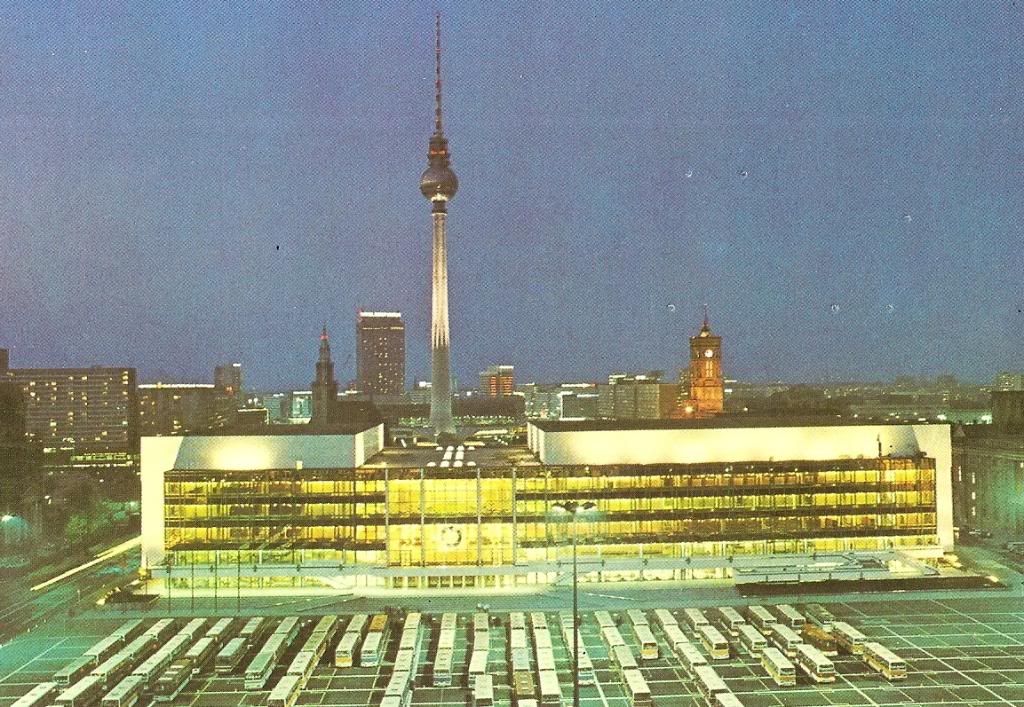
Those among us interested in radio will enjoy this one: one of those new fangled weblog thingies focusing on Radio Berlin International, the voice of the erstwhile German leftist dictatorship. For a collection of their QSL cards, as well as postcards from said erstwhile German leftist dictatorship, hier clicken, bitte.
27 July 2011
Today in History
East Berlin to be Rebuilt Into Red Super-Metropolis
BERLIN (NANA) – East Germany plans to rebuild Communist East Berlin as the showcase capital of the German Communist state and an architectural counter-attraction to West Berlin.
Walter Ulbricht, the East German leader, revealed that cornerstones for a complex of government buildings at Marx-Engels Square as a feature of signing ceremonies for a Soviet-East German peace treaty.
East Germany has conducted an architectural competition for the designing of the “ultra modern socialist metropolis.” Professor Max Hensermann, the architect in charge, says East Germany decided against imitating Moscow architecture.
“There are many forms of functional socialist architecture, and we will choose those forms best suited to East Berlin,” Henselmann said.
In 1953 East Germany began construction of the Stalin Allee, a gaudy boulevard designed as a propaganda façade for the rubble and ramshackle structures which make East Berlin and eyesore.
This avenue of “Moscow Modern” apartment buildings and luxury shops now stretches for nearly a mile along the pre-war Frankfurter Allee. It is to be extended to the Alexanderplatz.
But future new construction will deviate sharply from the Rococo and gingerbread of “Moscow Modern.” Henselmann indicated that the east Germans have decided on a modified Le Corbusier functional architecture with flowing lines.
The Marx-Engels Square, the pre-Communist Lustgarten, will house government offices, in effect replacing the pre-war Wilhelmstrasse and Leipzigerstrasse.
Foreign embassies will again be concentrated at the western end of Unter Den Linden, the famous Linden tree-lined avenue containing Humboldt (Berlin) University, the State Opera, and principal museums.
Since the war the Soviets have built a mammoth embassy near the former site of the U.S., British, and French embassies. The East German regime has now reserved a large tract in this area which will be subdivided and sold for embassy sites to countries recognizing East Germany.
COMMUNIST GAIETY
The opposite end of Unter Den Linden, bordering on the old Lustgarten, will be developed as East Berlin’s center of elegance. It will contain large department stores, cafes and restaurants, and even night clubs. Henselmann remarked, “who says there’s anything against gaiety in Communism?”
Freiedrichstrasse, pre-war Berlin’s amusement area, will retain the same character under the Communist reconstruction plans. A 200-bed hotel is to be constructed near the Friedrichstrasse railway station.
Hanselmann estimates that the major buildings in the program including Friedrichstrasse Hotel, will be completed by 1967. “The exact date depends upon the establishemtn of priorities for this program as compared with our general industrial development,” he explained.
“But we can promise this: By 1965 you will no longer recognize the city you see today.”
30 June 2011
For the Repose of a Good Soul
Cardinal Georg Sterzinsky, who kept the Catholic Church alive under the East German state, has died early in the day today at the age of 75.
Officially atheistic as Socialists need to be to justify their power, the DDR tried to convince the people that they had no souls. Eventually, they had to back off and leave at least some of the people to be free to guide their consciences in the way that they choose.
Born in 1936, his childhood years were the hardest times in the lives of the German people as a whole. He was ordained 11 years after the establishment of the Marxist-Leninist state. The best years of his adulthood were spent in a church that had to find a way to survive and coexist with the immutable, seemingly eternal oppressive state.
What is little understood about German Communism was that it was not generous to those in society who face difficulties in life. The churches, particularly the significantly larger Lutheran church, were depended upon for charitable work that (in a strange way,) was not provided by the “workers’ and peasants’ state” the way those needs would be covered in the west by government and civil society. Despite that, the invasive ideology of Marx and Engels was at war with faith. It though it needed to BE the only faith, but failed in the same way that it couldn’t serve the needs of society.
The all-powerful nanny state still depended on the people of faith that they were at war with to provide for those in need. Remember, in a command economy, those who don’t work are of inherently no use to the state.
05 May 2011
A Damned Good Read
Despite the usual European treatment of Americans as passive and two dimensional, as if they’re simply furniture, the story is an excellent one.
